We are one of FOE's local groups, organised like other groups in Wales through FOE Cymru, whose office is in Cardiff - Castle Arcade Balcony, tel 029 20229577. Contact us, Barry&Vale FoE via greenkeith 'at' virginmedia.com, tel. 07716 895973

Sunday, 16 May 2021

Sad death of Barry&Vale Coordinator, Keith Stockdale RIP 24 April 2021

Obituary   (amended with additions 31 October 2021)
    Keith was politically active as Labour Councillor from 1979-1983, then the miners' strike of 1984-5 when a strong Barry group held rallies and collected money and stuff on King Square. He was also active with the Anti-Apartheid movement as it grew from a pressure group to a mass movement with a consumer boycott and demand Nelson Mandela: Freedom at 70. At the end of the 80’s, he was prominent against PM Thatcher's 'Poll Tax', standing as Communist candidate in the 1989 County elections. Keith became active on local environmental issues in the 90s, campaigning against the one-way system proposed to replace lower Holton Rd (via Merthyr St and a continuation of Wyndham St). He joined Barry FoE and assisted FoE's coordinator (from 1995) Byron Lewis in holding up Council plans to fill one of Barry’s two Graving Docks with toxic materials from the derelict western dockland. Byron found him a breath of fresh air, being like-minded and confident on eco-matters. Sponsoring legal action, they forced the Council to put in a lining to stop the pollution leaching into the main dock (at a cost of ~£1million the Council wanted to avoid).  They delayed the Council's intention to give away Central Park for a supermarket (developers Centros Miller) - the Council paid to move the Bowling Green, but a FoE-supported judicial review fronted by local mums whose kids depended on the Park held up the land transfer – long enough for Kwiksave to build Barry's first town centre supermarket down Thompson St, causing Centros to pull out in 2001.  Then the Vale Council proposed to pull down the Town Hall, all but the facade, and build shop units on one side of King Square.  Keith was in the public campaign which won keeping the historic building, with a new Library building added at the rear. 

Barry's Chemical Complex 
   Campaigning to clean up Barry's chemical companies was another of Keith's interests - with noises which each company denied, blaming the others. Dow Corning did admit to spots on car paintwork, but not to harming people’s health. FoE loaned a "Grimm" particulate monitor, in the early days of these pollution monitors. With the Cadoxton activist Joan Holt, Keith set it up to record pollution near the Cardiff road.  This found sharp early-morning peaks, with traffic particulates peaking later, showing the plant being cleaned out via the chimneys - prior to restart for each morning’s shift.  This led to requirements for continuous monitors at Dow Corning and other plants.  Byron Lewis took the “Grimm” monitor to some other FoE groups in south and north Wales
Regulations were also brought in on major accident hazards (CIMAH / COMAH) and planning, which led to the primary school being closed.  The derailing of chemical tankers in October 2011, with evacuation of many families, led to the realisation of how dangerous were the movements of VCM from Merseyside (vinyl chloride monomer - highly carcinogenic and potentially explosive).  Ships were brought in instead and soon afterwards BP Chemicals sold the plant, ending the shameful deaths from VCM liver cancer (angiosarcoma) of staff working there. Thus Keith, living then in Cadoxton, played a part in taming Barry's chemical works at a time when the authorities treated them as untouchable, because of the high-paid jobs. 
Move from Cadoxton to Castleland 
   Keith moved up to Castleland and became Plaid Cymru councillor for the ward in 2004-2008. He then took on the role of FoE Coordinator from Byron Lewis, his campaigning "twin".  He extended FoE support to campaigns beyond Barry - over the ash mound at Aberthaw power station (stopping it rising further, so they switched to infilling Aberthaw quarry); over housing land at Llanmaes offered for the privatised ‘Metrix’ training facility (abandoned, but the Vale retained the greenfield housing); over Tesco’s attempt to buy golf course land at Bryn Hill and over the Vale’s proposed road from Caerau to Pencoedtre across the Wenvoe valley. Won some, lost some.  Keith introduced new members to the group, inspiring them to challenge and resist where possible, and was always ready to stand in at short notice to chair public meetings etc.
2009: two incinerators hit Barry
    The Vale had an enthusiastic recycling officer, Brian Mayne, whose efforts FoE very much supported.  But he was replaced by a guy who insisted 30% was the maximum recyclable.  This meant Barry was to have a ‘Biogen’ waste incinerator by Rank’s Flour Mill and a ‘Sunrise’ waste wood incinerator on the Castleland side.  The Vale approved the former and refused the latter (against officer recommendation), which the Welsh Government then approved after a public Inquiry.  Keith and FoE led sustained public resistance and neither proceeded.   But in 2015, the Vale officers pushed through renewal of the ‘Sunrise’ permit, despite the public campaign.  Big money came in from Aviva, FoE set up the separate DIAG campaign in which Keith was a leading light.  And as we see today, the plant has been built but is not able to operate.  Officers bending the law to avoid environmental impact assessment (EIA) has proved under FoE pressure to be the project’s Achilles heel.  The announcement in March of a Welsh moratorium on new incinerators reflects the public distrust and opposition from Barry and other parts of the country. 
Severn Estuary 
   Barry and Penarth FoE groups living by the Severn Estuary have always engaged with issues around a tidal barrage. The Bondi barrage from Lavernock Point would have been destructive to our local environment but give national benefits as a major renewable energy source. Local FoE tended to argue for a smaller tidal barrage upstream, near the Severn Bridge. FoE’s leader, Jonathan Porritt came down for a TV confrontation at Aberthaw’s Blue Anchor pub, where Keith stood his ground. That was about 1990 – two decades later the two FoE groups had merged and we saw off the second attempt to get the Lavernock tidal barrage, but by that time the Estuary was designated a European conservation site and major wildlife organisations were on-side. The Cardiff Lagoon idea for tidal generation was more interesting; Keith brought in the Swansea Lagoon company to explain it. In the end, he was opposed to it, for enclosing a large section of the wild natural estuary and for power generation with gaps – gaps that had to be filled with fossil-fuelled power. Despite central FoE and Welsh political parties lining up in support, the Swansea lagoon was vetoed by Westminster; with it the Cardiff lagoon idea disappeared. The group remained founder-members of the Marinet network of coastal groups (a FoE spin-off) who are like-minded on coastal environmental issues. 
Hinkley nuclear plant 
   Keith was staunchly anti-nuclear, opposing the Hinkley-C nuclear station throughout, and regretting the environmental movement’s failure to stop it – as in the last years he viewed it building across the Severn from his home. In 2017-18, the Hinkley project’s intention to dump excavated mud off Penarth Head hit us. Central FoE shunned us, but Keith continued to argue the mud would surely contain historic nuclear discharges and supported the ‘Geiger Bay’ campaign led by Neil McEvoy to require full testing of the sediments. When interviewed for BBC TV on Penarth Head, he prepared to say a few sentences in Welsh - seeing that we needed to engage the Welsh-speaking community on the nationalist point of English mud dumped on Wales. The first stage dumping was lost in 2018, with the legal decision on EIA came too late. But Keith had the satisfaction of the campaign’s success on the EIA requirement in 2020, then of the second stage dumping application running into sand early this year.

Sincere environmentalist 
   As people have said, Keith was one of life’s sincere people and true environmentalists, who put that above any political interest. After finishing his teaching career (primary schools in Wenvoe and Llangynwyd), he worked with the Forest Farm conservation scheme, leading teams of youngsters on conservation projects around Cardiff and the Vale. When its funding ended, he joined Cardiff and Vale College to assist special-needs students. He was an inspiration to many on environmental issues. Keith was frequently seen out cycling, from his early days when he cycled to his primary school teaching job at Wenvoe to cycling part way to his conservation job at Forest Farm (he drove by car till he met Cardiff traffic, then parked and pulled out his bike for riding up the Taff trail). He regularly participated in the “Barnardo” cycle-rides, 40 miles around the Vale.  In recent years, Keith was often out on his bike to keep fit and enjoy the Vale countryside.  He played the flute for enjoyment, with a small group who played at a few clubs and ‘open mic’ evenings.  He was able to enjoy last ‘lockdown’ summer, out many times on local beaches with grandchildren.

Changing orientation of FoE, England & Wales
 
   Keith has lived through many changes in Friends of the Earth, from when FoE Cymru was independent, supporting campaigns on local issues (and the Welsh “acid rain” issue), then absorbed into the England & Wales FoE in 1994 when centralised campaign goals got priority (from GM-crops to ‘cuddly’ bees), to recent years when local issues have been given greater prominence. He did not allow his criticisms on some issues to detract from overall loyalty to FoE, carrying their banner to many public events. Throughout, Keith held to his strong belief in local activism, and gave FoE’s support to local campaigns in Barry and around the Vale. 
Environmental activism 
   Keith contributed much to Barry over the years. Though politically engaged – a Plaid Cymru member for two decades, his main achievements were with Friends of the Earth, where he showed that community environmental activism achieves. Enthusiastic to the end, despite his COPD, Keith was looking forward to meeting the Barry&Vale group and resuming public activity post-lockdown, when death struck on 24th April.  He lived to see the Biomass incinerator deadlocked if not yet dismantled.

Sunday, 13 September 2020

Severn Seabed mapping of humped material - NRW in denial

The Cardiff Grounds dump-site (LU110) normally disperses dumped dredgings in the strong currents, but the Titan survey identified a lot of mounds on the seabed around a metre high and 30 metres across. Their radar survey was carried out 6 months post-dumping from the huge Pagadder and Shloeber barges of Hinkley material. As the site is supposed to be a dispersal site where material is swept away in the strong currents, NRW asserts the site is “sustainable” as the material would “disperse over time”. They also claim the sea bed has not been raised on the average, though Titan’s mapping shows it’s generally higher.
A third claim by NRW is that it’s impossible to attribute the left-over sediment to Hinkley.
Penarth Times report 10 September 2020

Here is one of Titan's detailed images - seabed height differences between the April 2019 and 2018 surveys
The images show a series of four discrete disposal events along a transect (“Transect 01”), with each disposal identified as two parallel lines of deposited material (i.e., accretion), consistent with material being released through the hopper doors of a dredging vessel.

To the left is Titan’s result that implies accretion (orange) through much of the area as well as the mounds showing recent dumping. to the right is NRW’s favoured adjustment that implies the area has generally eroded (white to blue), except for the humps. This 'adjustment' comes from moving up the zero by 24cm. This picture shows that though an adjustment be a few cm is possible, 24cm is implausible. The mounds would be expected to spread and raise the adjacent levels.

Elevations were also depicted by Titan's Figure 7:


It appears that these parallel mounds did not spread much laterally in the 6 months post dumping, except for the right-most trail where the left side slumped into the depression.

Grab-samples of the seabed were also collected by Titan. One sample taken happened to be quite close to the lowest of the 4 trails (upper picture); it has an extreme composition of 95% mud and is characterised as “very poorly sorted”. The sample point (S4) happens to be along the parallel trail and within about 30m of the metre-high mounded material. It’s highly likely to come from Hinkley, not from a shipping channel dredger.

The Titan report is in no doubt that they see deposition in the April 2019 survey compared with the pre-dumping survey in 2018. They looked carefully into the zero-ing uncertainty, settling on 8.5cm. The NRW's 24cm on top of this implies erosion of the seabed in the area of the mounds. They are in denial not just that the mounds are Hinkley material, but also that much of the dumped material could have remained in the dump site.

Tuesday, 1 September 2020

Severn Seabed Survey shows heavy Hinkley materials

Seabed surveys before and after dumping were required under a Licence condition. The report  was issued quietly in July 2020 following an April 2019 survey and much revision (8th Edition). Released after a Freedom-of-Information request by Barry&Vale FoE    https://publicregister.naturalresources.wales/Search/Download?RecordId=34343 
Titan Environmental Surveys Ltd conducted a bathymetric survey and collected some grab samples between 3rd and 12th April 2019.  The 12 samples were analysed for sizes, from clay to gravel. compared with pre-dumping levels the samples showed both coarse gravel and clay remained from the dumped material. 
Titan Explorer surveyed the seabed of Cardiff Grounds dump-site in April 2019
The bathymetry – depth measurements from the vessel - mapped the heights of the seabed compared with pre-dumping heights. Titan found problems in that the total increase was greater than the volume dumped.  They found an antenna offset and corrected for it. But this was not enough, so CEFAS invented a further fudge (3 times as big) which reduced the total amount remaining on the seabed to 103 cu m (compared with 58 000  cu m dumped).  Incredible!
The bathymetry differences pre/post-dumping are shown below.  The red spots show mounds about a metre high and 30 metres across, each might contain 50-100 cu m.  The Titan survey links the pattern to trails of the dumping boats.  The distribution of the spots shows the dumpers avoided going close to the eastern limit of the triangle, but also avoided the top of the triangle and the western apex.  The licence prescribed that EDF must dump evenly over the dumping ground – to avoid building up banks – which they failed to do.
Difference map of seabed pre/post-dumping
North is to right, West at top.  The lower left (blue) corner shows erosion.
The spots (red) around 1-metre high are identified in more detailed maps as dump trails (east-west).
Thus even after 6 months of the stormy winter weather 2018-19, the claim by NRW that dumped materials would simply disperse in the strong currents is shown to be untrue by both the sampling and the bathymetry.  NRW’s error stems from their equating ‘capital’ dredge with port maintenance dredge, because the Cardiff Grounds site was classed as a dispersive dump-site to take port and shipping channel dredging. 
Much of Hinkley’s capital dredge removes consolidated or hard stuff (clay, pebbles, cobbles etc) whereas as maintenance dredge removes short term, mobile soft sediments.  International rules (OSPAR) say solid material should be separated and not dumped at sea, but NRW insists on classifying all as port dredgings and reports them to OSPAR as this.

Friday, 21 August 2020

Penarth Esplanade Parking proposals


Comments/objections on Parking proposals for Penarth Esplanade ref. IF733,  submitted to Vale Council (c1v@valeofglamorgan.gov.uk)

We want these proposals changed, primarily to remove parking adjacent to Beachcliff to free the street-space for al-fresco eating and snacking away from car-fumes and to allow unobstructed sea-views.  The 2-hour limit to apply only in the summer season.
  • extra disabled parking is welcome outside Alexandra Court (past the bus-stop); do apply the 2-hour limit to all the disabled parking. Carry out an Equality impact assessment to see if more of the 2-hour parking should be reserved for disabled persons.
  • remove parking in front of Beachcliff for the chip-shop, wine-bar and restaurant (when it re-opens), to make permanent the use for outdoor tables and sea-views unobstructed by cars. Only unloading and trades-parking allowed at the south end.
  • guarantee wardens will check the 2-hour limitation during weekends and busy times
  • apply the 2-hour limit only in the 'season' April-Sept., to save the costs of parking wardens at slack times.
  • reduce the 'no-parking' on the east side of Cliff Parade, from the entrance to no.7 southwards, which was needed and used without undue problem when the Council closed the car-park and does not impact on the residents of the brash new fenced-off house.
  • extend the 2-hour parking up the straight part of Beach Rd, east side, which has been used in the past without problem and without enforcement to stop it, for say 50m instead of 24.0m
  • agree that parking outside the Italian Gardens will be suspended on high-summer days, to allow busking and informal street activities.

Beachcliff Winebar, to the right of the Chip-shop, both taking up car-parking space post-Covid
Changes in words at: penarth.nub.news/n/changes-to-parking-proposed-at-penarth-esplanade-by-vale-council

Thursday, 13 August 2020

Penarth Town Council's post-COVID traffic plans - unwanted and unacceptable

Friends of the Earth Barry&Vale oppose Penarth Town centre traffic and parking changes
www.penarthtowncouncil.gov.uk/ptcmedia/uploads/20.08.03A-Town-Centre-Proposals-Amended-for-PTC.pdf

Encourage and facilitate street-trading - via partial pedestrianisation - yes!
But no to the drastic 1-way traffic changes and crammed car-parking.
Disabled parting in lower Glebe St - yes - but with sufficient spacing.

The Active Travel (Wales) Act requires priority in any new scheme for walking and cycling. A traffic scheme motivated to maximise parking is out of sync.  Though not the highways or planning authority, the Town Council should be aware of the transport policies of the VoG Council and WG, especially the latter’s guidance on active travel, and therefore indicate how to include cycling priority in their plan. The parking and one-way ring road proposals appear to ride roughshod over the Vale’s Active Travel network plans agreed with the Welsh Government.  They pay no regard to “walkable neighbourhoods, where a range of facilities are within walking distance of most residents, and the streets are safe, comfortable and enjoyable to walk and cycle.”  

The Well-being of Future Generations Act requires planning for sustainability, which excludes any increase in car-parking. No justification is given for replacing the on-street parking lost under pedestrianisation.  Parking places have already been lost due to Covid measures, but there are still many vacancies.  Nobody can foretell the post-Covid ‘new normal’, with more shopping on-line and increased readiness to walk and cycle for health and fitness.  The WG offers funds to increase the attractiveness of active travel; try that first and wait to see how things work out before trying any disruptive schemes.

A one-way traffic scheme of necessity forces longer vehicle journeys, with noise air pollution and CO2 emissions as direct effects.   Further, in deterring some walking and cycling trips, the one-way scheme has indirect effects that may be as large or larger.

Any planning has to recognise existing walking and cycling routes and links to them. 
1. Penarth Haven (Pont-y-Werin bridge) –Paget Rd – Arcot St  - Hickman Rd – Penarth Station – Railway path  (National Cycleway Route 88)
2. Cardiff  Bay Barrage –Paget Rd – Clive Place (or Albert Rd) – Beach Hill – Esplanade (Wales Coastal Path) and Stanwell Rd – The Railway
3. Pont y Werin to Penarth centre via Windsor Rd - Plassey St to join Arcot St route, or to the end of Plassey St to join the Albert Rd route to the Esplanade.

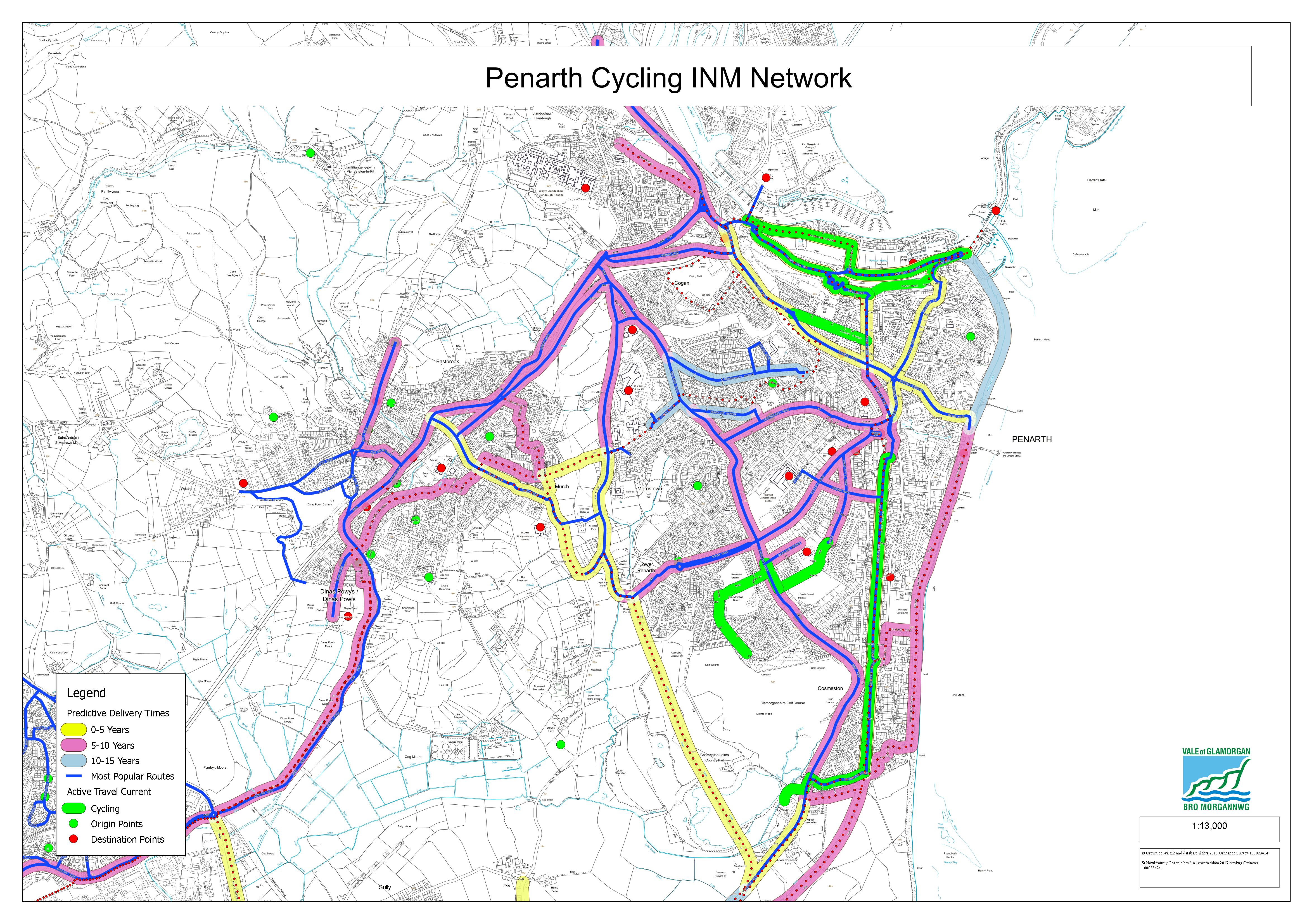
Windsor Rd from the Plassey junction through to the Esplanade and route 2. to the Railway are current 5yr projects in the 2017 map of the  Penarth Cycling INM Network https://www.valeofglamorgan.gov.uk/Documents/Our%20Council/consultation/Active-Travel/Penarth-CYCLING.jpg  Windsor Rd and Albert-Stanwell Rd are routes in the 2017 map of the  Penarth Walking INM Network.  Converting Albert and Stanwell to parking streets with chevron parking contradicts the Vale Council’s active travel plans, required in the Act and agreed with Welsh Government.  Bridgeman Rd is likewise designated a walking route. Increasing the traffic by the one-way system may increase pollution and worsen safety, requiring these to be taken into consideration.

The Windsor Rd route passes through the section proposed to be pedestrianised. 
The Town Council’s plan fails to say whether cycling is to be permitted in it. If you propose to divert it via the one-way traffic ring, you have to address the conflict with Active Travel policy.
We are not aware of any problems with cycling in the shopping streets.  Occasional cycling the ‘wrong way’ on wide lower Glebe St will be resolved if pedestrianised. 
We support pedestrianisation as long as cycling is permitted for access to shops etc.


The WG Active Travel guidance advises two-way cycling on 1-way streets “wherever safe and practicable”.  Contraflow cycling up Stanwell Rd and Albert Rd needs to be provided, both for trips to the town centre and for the local cycling network.  It has priority over changing parking to chevron-style.

The proposed chevron parking does not provide for larger vehicles, neither in width (all spaces are the minimum 2.4m, 2.7m is becoming standard) or length (4.8m). Unless a 1-metre buffer is provided as in Arcot St, protruding vehicles present a hazard while policing the parking to stop them is not easy.  2.4 m leaves to little space for frail elderly stick-users and wheelchair users.  If this minimal cramped chevron parking is excluded, the claimed advantage in cramming in more cars becomes much less.

Allowing buses on the Stanwell Rd-Rectory Rd route is important for bus operation.  Waiting time at the Windsor Terrace terminus with driver access to the public toilets is needed. More bus stops are needed to encourage sustainable travel to the centre.
  • one at lower end of Windsor shops (or outside the RAFA club)
  • unofficial stops in Plassey St (for 89) need to be in plans, at Glebe St and High St junctions; these need build-outs (removing parking places)
  • the stop at bottom of Clive Place needs a build-out.
  • the terminus stop on bottom of Albert Rd needs to take 2, occasionally 3 buses and a big bus-shelter
  • the first Stanwell Rd stop should be at the Rectory Rd corner, close to the Library.
Blocking half the 'clock' roundabout for unloading and pick-up is unacceptable.  Emergency and other vehicles need passage, while the 88 bus turns around it. 

Equality Act discrimination.

Despite the Town Council claims to make Penarth ‘disabled-friendly’, no consideration is given to contrary aspects of these plans.  The over-narrow echelon parking replaces roadside parking suitable for disabled persons. Buses less accessible with bus-stops on slopes making boarding difficult for disabled persons.  The proposals discriminate against women as cyclists as Planning Policy Wales considers women are more likely to be deterred from cycling by perceived dangers of cycling on the one-way high-traffic ring.

Wednesday, 17 June 2020

Hinkley nuclear station: NRW sampling approval just issued

   Halt the Dumping of Hinkley Mud in the Severn Estuary


NRW in their Position Statement** now admit there was leakage of nuclear spent fuel in 1969 into the spent-fuel cooling pond and that Magnox were convicted of not maintaining the effluent filters on liquid discharges from the ponds.

The effluents included plutonium and EDF have now agreed to use alpha-spectrometry to assess the sediments for it.

NRW and EDF repeatedly refused this previously, claiming gamma-spectrometry was adequate.  Neil McEvoy AM was ridiculed for demanding it and the Environment minister accused critics of “scaremongering” over nuclear contaminants in the Hinkley mud.

A virtual meeting of opposition groups on 15 June received a presentation Prof. Keith Barnham of Imperial College, with his evidence on Hinkley Point's plutonium discharges in the 1970s and 80s.
Friends of the Earth Barry&Vale are opposing the mud dumping both on the basis of nuclear contamination and also that sea dumping of construction of materials is banned under international treaties to which the UK is committed.  In this case, EDF could use or dispose of the excavated material on their huge construction site, so cannot argue an exception.
    Max Wallis of the FoE group says: “the NRW are clearly wrong to ignore this basic ban on sea-dumping by declaring it ‘out of scope’.  Welsh politicians need to tell NRW that we have the power and the duty to apply the international ban on dumping in Welsh seas.  End of.”

** for more on NRW’s  Position statement, see  Halt the Dumping of Hinkley Mud in the Severn Estuary 

NRW requirement on Plutonium sampling using alpha spectrometry reads:
8.   The chosen sample location for plutonium should be explained. Clear justification on the number of stations in relation to risk will need to be provided. In addition, each core chosen for such analysis will require subsamples to be taken from all depths.  Alpha spectroscopy will be used to determine the plutonium (Pu-239+240) and americium (Am-241) isotopes. Alpha spectroscopy will be undertaken on cores which are also used for the gamma spectroscopy in line with ISO 185891, to enable direct comparison of results from each analysis.

After contamination by nuclear fuel-element ruptures in 1969 etc., the cooling ponds were emptied to sea over many years (the license limited the total radioactivity released) till 2014. For many of these years, the filters were not maintained, so potentially letting through radioactive particles.   NRW's answer given to the NFLA objection says:  
The Environment Agency is aware of an incident in the R1 fuel pond in the late 1960s which led to a release of fission products into the pond. The pond has now been treated and emptied of effluent and sludge.
 Discharges are matter for Magnox Ltd, but the Environment Agency is aware of these historic events that may have led to higher levels the Hinkley Point A pond excursion in the late 1960s. The EA also prosecuted Magnox for poor maintenance of effluent filters at Hinkley Point A (and Bradwell) in June 2001. They (Magnox Electric) were fined £100,000 plus £28,000 costs.


Tuesday, 24 March 2020

NRW refuses to disclose the Cardiff dump-site Licence

NRW refuses** to disclose the Licence they hold for the Cardiff Grounds dump-site.
NRW are the WG’s marine licensing authority, yet say FoE have to go to the Welsh Government for the licence (dating from the 1980s).  

FoE believes the licence applies for sediments from dredging ports and shipping channels and does not permit dredgings from the capital works at Hinkley Point.  NRW refuse to disclose the licence because it would show they ignored it for the previous dredging campaign.

NRW fail to require EDF to show why they seek to dump a further 600,000m3 (840,000 tonnes).  This volume is more than twice the original demand, on top of the original plan. There is no planning permission for this extended 'dredging'.

Nor do NRW report on compliance with the dumping license issued to EDF.  A condition was placed on the previous dumping that material be spread throughout the dump-site, to avoid mounding of the clays and gravels.   We think they failed to spread it evenly and dumped material outside the limits of the dump-site. 
MV Sloeber opening its bottom to dump Hinkley mud on 16 October 2018.
It was caught with its bottom opened (sh***ing) outside the dump site.
The NRW allowed EDF to submit a Summary of Dredging Campaign 2018-19 that fails to meet quality requirements for reporting and specifically the international OSPAR requirements.

NRW told everyone that they met all the international licensing requirements on sea-dumping last time.  They did not.  They ignored the 2014 IMO guidelines that require them to minimise sea dumping, and expect to do the same again. 

The 1972 London agreement stopped sea dumping, with some exceptions for dredging operations.  The Protocol added in 2014 tightened  the requirement to reuse dredged material on land.  NRW are still in the dark ages, believing that sea dumping is the first choice.

## Hinkley Mud: NRW flouts licence rules gives FoE's detailed response to NRW's proposal ##
 -------------------------------------------------
** NRW Refusal
On Tue, 11 Feb 2020 at 12:27, Marine Licensing <marinelicensing@cyfoethnaturiolcymru.gov.uk> wrote to Friends of the Earth Barry&Vale
Thank you for your email to Mr Evans. As part of a pre-application request the Marine Licensing team has received the proposed sample plan from EDF for further dredging at Hinkley Point C construction site. This will help us understand whether the material can be deemed suitable for disposal at sea. We have not received a marine licence application from EDF. The consultation we are running is to provide members of the public with the opportunity to express their views on the suitability of the submitted sample plan and this will inform our pre-application response. 
As with regards to your question of the operating licence for Cardiff Grounds; this disposal site is ‘designated’ by Welsh Government and further information on its designation should be requested from them. The area has been used since the mid-1980s and each marine licence application for disposal at the site is assessed on its own merits. 
Regards,  Maria
   Trwyddedu Morol/ Marine Licensing
   Cyfoeth Naturiol Cymru / Natural Resources Wales