We are one of FOE's local groups, organised like other groups in Wales through FOE Cymru, whose office is in Cardiff - Castle Arcade Balcony, tel 029 20229577. Contact us, Barry&Vale FoE via greenkeith 'at' virginmedia.com, tel. 07716 895973

Tuesday, 24 March 2020

NRW refuses to disclose the Cardiff dump-site Licence

NRW refuses** to disclose the Licence they hold for the Cardiff Grounds dump-site.
NRW are the WG’s marine licensing authority, yet say FoE have to go to the Welsh Government for the licence (dating from the 1980s).  

FoE believes the licence applies for sediments from dredging ports and shipping channels and does not permit dredgings from the capital works at Hinkley Point.  NRW refuse to disclose the licence because it would show they ignored it for the previous dredging campaign.

NRW fail to require EDF to show why they seek to dump a further 600,000m3 (840,000 tonnes).  This volume is more than twice the original demand, on top of the original plan. There is no planning permission for this extended 'dredging'.

Nor do NRW report on compliance with the dumping license issued to EDF.  A condition was placed on the previous dumping that material be spread throughout the dump-site, to avoid mounding of the clays and gravels.   We think they failed to spread it evenly and dumped material outside the limits of the dump-site. 
MV Sloeber opening its bottom to dump Hinkley mud on 16 October 2018.
It was caught with its bottom opened (sh***ing) outside the dump site.
The NRW allowed EDF to submit a Summary of Dredging Campaign 2018-19 that fails to meet quality requirements for reporting and specifically the international OSPAR requirements.

NRW told everyone that they met all the international licensing requirements on sea-dumping last time.  They did not.  They ignored the 2014 IMO guidelines that require them to minimise sea dumping, and expect to do the same again. 

The 1972 London agreement stopped sea dumping, with some exceptions for dredging operations.  The Protocol added in 2014 tightened  the requirement to reuse dredged material on land.  NRW are still in the dark ages, believing that sea dumping is the first choice.

## Hinkley Mud: NRW flouts licence rules gives FoE's detailed response to NRW's proposal ##
 -------------------------------------------------
** NRW Refusal
On Tue, 11 Feb 2020 at 12:27, Marine Licensing <marinelicensing@cyfoethnaturiolcymru.gov.uk> wrote to Friends of the Earth Barry&Vale
Thank you for your email to Mr Evans. As part of a pre-application request the Marine Licensing team has received the proposed sample plan from EDF for further dredging at Hinkley Point C construction site. This will help us understand whether the material can be deemed suitable for disposal at sea. We have not received a marine licence application from EDF. The consultation we are running is to provide members of the public with the opportunity to express their views on the suitability of the submitted sample plan and this will inform our pre-application response. 
As with regards to your question of the operating licence for Cardiff Grounds; this disposal site is ‘designated’ by Welsh Government and further information on its designation should be requested from them. The area has been used since the mid-1980s and each marine licence application for disposal at the site is assessed on its own merits. 
Regards,  Maria
   Trwyddedu Morol/ Marine Licensing
   Cyfoeth Naturiol Cymru / Natural Resources Wales

Friday, 28 February 2020

SUCCESS! Council comes out firmly against Biomass Incinerator

 All but one of the Vale of Glam Councillors voted on Wed. 27th to
1 Share public concern that no EIA was ever done
2 Review all VoG planning decisions on the incinerator
3 Urge Welsh Govt to issue a Discontinuance Order
4 Consider the expediency of taking enforcement action
This massive industrial plant, close to homes, has no valid planning permission.
Many Conditions on the Outline permission are still unmet, and the buildings differ.
They have to re-start with
 a proper EIA for a DNS application, or just give up.
The Welsh Minister has to do what she has been avoiding since last April when her Planning officers advised her to issue a Discontinuance Order to comply with her duty to prevent the plant operating without EIA.

The Council Motion's 4th point was amended from the original moved by Cllr Vince Bailey that specified the cessation of all operations on site.  These words were copied from their own Planning Officer who warned the company that 
the only remedy to such a breach of planning control would be to require the removal of the development in its entirety or, at the very least, the cessation of all operations on site.
That is what the public is expecting, now that the Incinerator is in breach of a whole slew of Conditions on the 2015 outline planning consent.  The Vale officers allowed them to breach conditions on noise, emissions and no nightime working when constructing the plant.  At last the Councillors have stepped firmly against this lawless company.

Saturday, 15 February 2020

Objecting to JME's Incinerator-linked Waste Site on Barry Dock

The Natural Resources Wales consultation lasted till 9th February.  
Many members of DIAG sent in objections.  Barry&Vale FoE concentrated on some fundamental points for rejection of the license application.  Winning the point that the process comes under the Industrial Emissions Directive (IED) will be important in stopping the current operations, supposedly restricted to a Standard License.
JME have also started a pre-planning consultation - their present operations have no planning consent, but the VoG Council has failed to enforce against them.

JME want to take in waste wood, sort and chip it to make fuel for the Biomass incinerator, and also receive incinerator ash for onwards transfer.  They would do this in the open air, spreading the harmful dust everywhere with no regard to impacts.  The waste-wood is classed as "non-hazardous" but of course the dust from chipping it can be and is hazardous when breathed in.  NRW officers appear not to understand this!

FoE Objection to License 
for   J M Envirofuels (Barry) Limited, Berth 31 Wimborne Road, Barry Docks
   We point out this application for sorting and shredding wood for use of incinerator fuel comes under the Industrial Emissions Directive, as the processes improve the nature of the fuel and its quality for feeding the incinerator.
We therefore object fundamentally to licensing it outside the Directive's requirements.
We are aware that the NRW has formally agreed to exclude changes to the "physical nature" from its definition of processes that improve the nature of the fuel.
We challenge this as a wrong decision that has no basis in law or industry usage.
# Standard descriptions include physical and thermal methods to improve fuel quality. 
A quick internet search finds the Conference publication describes "commonly used methods to improve biomass fuel quality by physical and thermal transformation" in Research progress of biomass fuel upgrading and distributed utilization technology, by Liu, Shuguang et al.  DOI - 10.1088/1755-1315/227/2/022002  IOP Conference Series: Earth and Environmental Science
# Elsewhere are descriptions of improving biomass fuel quality by densification and moulding, like processes for producing fuel pellets   Thus industry usage shows NRW were wrong to exclude physical treatments from their definition of methods that improve fuel quality.
# The physical processes proposed at Berth 31 in fact improve quality.
JME say they collect materials from skips, such as doors, window frames, roof timbers, kitchen cupboards, used work-tops etc. These are likely to include metal handles and fitments, window glass which they sort out.  Excluding non-combustibles by definition improves the calorific value. Thus sorting undoubtedly improves its nature as fuel.
# The remaining waste wood is unusable as fuel until it is chipped/shredded; large pieces have to be excluded as they pass through the system incompletely combusted. The chipping/shredding undoubtedly improves its nature as fuel for the incinerator.
We therefore object that this application be rejected, and one submitted under the more stringent requirements for a facility covered by the IED.
In the IED submission, we expect proper evidence on the nature of the dust from the process, much of which is not "sawdust" as stated but fragments of paint and non-wood materials.  Data from similar waste wood chippers must be supplied, on the nature and hazard of the dust, on health-experiences from people living close to such facilities, and on environmental effect of the dust including in leaching chemicals into surface waters.
The IED submission must justify each statement in the Risk Assessment, showing the capacity of drainage systems can cope with the heaviest rainstorms and worst-case firewater usage; restriction on recreational use of dock waters from run-off contamination etc.   It must detail all receptors liable to be affected, not use the vague term livestock, but include mussel-farms as well as fish stocks in Barry Dock.
The IED submission must also detail how the 20 000 tonnes of wood waste could be accommodated on this site, when the two 'maltese crosses' of chipped wood can hold at most 2000 tonnes. In what form is the rest to be stored?
Request for an IED licence that covers both the incinerator and Berth 31 that supplies it.  
NRW officers said they thought one licence could not cover two companies, yet the Directive allows this, as long as the specific responsibilities are set out. 
Reasons for a combined licence are that
# the incinerator cannot function without this supplier - and have signed a long-term contract with them.  
# The quarantine area to receive part-burned fuel in case of fire on the incinerator site is at Berth 31.   JME have to set aside that quarantine area.  
# The haulage road between the incinerator and Berth 31 is a private road, not subject to controls on sheeting of lorries or spillages (which can affect nearby receptors, including the Dock's controlled waters). Only by NRW requiring a combined IED licence can the haulage be brought under proper controls for the protection of people and the environment.

Wednesday, 5 February 2020

Hinkley nuclear station: New Cardiff Bay mud dumping plans


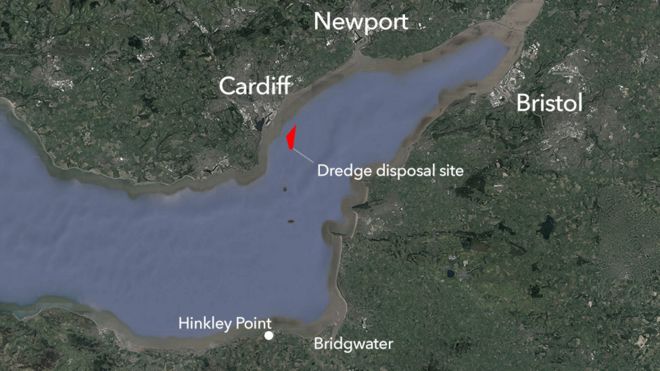
EDF Energy wants to "deposit" up to  600 000 cu metres (about 800 000 tonnes) of sediment dredged as part of building work for the Hinkley Point C plant into the sea off Cardiff Bay.
They got away with "only" 120 000t before, in 2018, and now think the compliant Welsh will give them an easy ride.   Natural Resources Wales (NRW) has received a plan for sampling and testing the mud, which will now be subject to a six-week consultation with specialists and the public.  NRW appear to have taken no notice of the basic errors in their previous license - including the lack of EIA confirmed in the High Court case - as summarised in the WANA briefing.


Map
Image captionThe mud disposal site in 2018 was located about a mile off the south Wales coast

EdF's Chris Fayers was interviewed on Radio Wales on 5th February, followed by FoE coordinator Keith Stockdale.
The same old yarn - Cardiff is the closest suitable dump-site; important to keep the dredgings in the Severn Estuary; our sampling was sufficient last time and we're sure it will show no problem this time.  The radioactive dose to anyone is the same as eating bananas.
EdF use calculations as if the mud was dumped in the open sea - a model that is used for Sellafield's discharges in Morecambe Bay. 
As Keith Stockdale pointed out, the Severn Estuary mud does not get swept down the channel.  It swishes back and forth with the twice daily tides, some deposits on mud banks and in saltmarsh, and some gets into the wind as microspray drops.  From the mud banks, it moves up estuaries like the Rhymney and Usk.  When the mudbanks dry out, the mud particles blow onto land and are taken up in crops.  The nuclear contaminants get to people via inhalation and local foodstuffs. 

Thus the model calculations ignore sea-to-land transfer processes established by science.  They assume most or all of the mud disappears to the open sea, yet common observation sees mud banks accumulating and saltmarsh building up.  EdF's Fayers indeed argued for retaining the mud in the Severn Estuary system, as happens to much of it, but NRW has no idea how much reaches the land, nor have they yet required EdF to provide evidence on it.

The Cardiff Dump site was designated only for dredgings from harbour channels.  It was never licensed for ‘capital’ dredgings and not for the heavy clay (64% of the total) which EdF intend to dig out from their massive tunnels for installing 7-metre seawater pipes for cooling water.  Their closest dump site is in fact on land, with their other construction waste.  EdF's real motive in trying to dump in the estuary is they expect the mud to contain radioactive pockets of material that they’d have to test and deal with specially.  How much easier for them (and cheaper) to dump in our sea!

Sampling last time failed to meet basic standards.  Most samples were just recent deposits scooped off the seabed (1-3cm).  The few borehole samples showed mixed results, indicating patchy radioactive deposits down to a metre or two.  The 3 boreholes out near the planned pipes were quite insufficient on international standards for the volume excavated (7-15 sampling positions are specified;  more if contaminants are found to be patchy).   The Senedd Petitions Committee maintained there should be more samples at depth, but the Minister ignored them (supported by Labour on the party whip).

Since that time, further evidence has been found that the nuclear station was discharging elevated levels of radioactivity in sludge from the cooling ponds (decommissioned 2014), arising from mishaps with the spent nuclear fuel elements about 1970 (Prof Keith Barnham).  The greatest fear is of the ‘hot’ particles of used nuclear fuel released in that sludge, because these are not detected by the conventional analysis - yet just one getting into the human body would be very dangerous.

Artificial radioactive components were detected in the 2013 sampling.  Caesium-137 and Americium-241 are the two fingerprints of nuclear reactor products. They are just visible on the CEFAS graph below, because that has been scaled to show "dose", not specific radioactivity.
As plutonium Pu-241 is the source of Am-241, the amounts of Pu-241 are inferred from the intensity of gamma radiation from Am-241.  The CEFAS graph makes the artificials look insignificant, but harm depends not on the gamma-ray dose, but depends strongly on whether the elements are taken up into food and the human body.  U-238 is 30-60% higher in the 3 relevant deep samples, so the real total dose may come close to the 10uSv/a limit.

Plutonium (Pu) is 30x more abundant than given by the government CEFAS analysis.  That assumed Pu-241 is 90% of total Pu (as average in Sellafield discharges), but Hinkley-A magnox reactor had only 3% Pu-241 in the total Pu, being operated to produce mainly ‘bomb’ Pu-239. So their basic numbers are seriously wrong. 

Pu has the property of being quickly adsorbed onto mud particles, which then mainly settle out locally, in the Bridgewater Bay mud.  The mud builds up by a mm or two per year, so deeper samples indicate levels of Pu in earlier years.  Sampling at a sequence of depths allows past discharges over the decades since 1970 to be assessed. Last time they just measured the average in 20cm and 110cm long cores, looking as if they want to hide the pattern of Hinkley's secret past discharges.

NRW failed to require assessment of what happened to the dumped mud in 2018. It's massively insulting to Welsh people to imagine EdF could play the same tricks again, get supine politicians to say it's not radioactive, so they can spread 6 times more mud with historical Hinkley contaminants on our beaches, mudflats and river estuaries, knowing there's no safe level of these nuclear fuel radionuclides and that dangerous 'hot' microparticles may be included, 

Saturday, 4 January 2020

Long-outdated Air Pollution assessment still used in Wales

The official Welsh (WG) classification of Air Pollution levels (link) is inherited from the old Department of Health (DoH), based on COMEAP 'experts' who've changed their minds below). It’s still posted up for use, despite new Welsh policy issued in 2017. This included statutory guidance to Local Authorities on giving special consideration to the long-term risks posed to babies and children via exposure to air pollution. The old DoH/WG classification doesn’t.  This daily air quality index (DAQI) is also based on quite outdated standards for adults.

The World Health Organisation produced guidance in 2012/13, including identifying PM2.5 as a human carcinogen, but the WG took no notice until the Minister’s statement of June 2017. Revised WHO Air quality guidelines are due out in 2020. 

The WHO annual mean concentration guideline for particulate matter stipulates that PM2.5 not exceed 10 μg/m3 annual mean and 25 μg/m3 24-hour mean; also that PM10 not exceed 20 μg/m3 annual mean, or 50 μg/m3 daily mean ( 24-hour).  PM2.5 is most closely related to ill-health impacts (see below).

The DoH/Welsh classification clings to the pre-WHO numbers, calling PM2.5 values below 35  low” (40% higher than the WHO limit) and below 53 “moderate” (double the WHO limit).  It’s highly remiss of the Environment Minister that she has failed to withdraw this completely misleading classification and issue a new one for guidance of the people of Wales.


Vale of Glamorgan monitoring of the Barry 'Biomass' Incinerator
The Council has purchased two monitors that measure PM10, PM2.5 and NO2 every 15 minutes.  The averages for each hour are now posted daily.   We presume the numbers are accurate as the monitors have been working for two years.  However, users should ignore the low/moderate/high classification and colouring, which are the old defective WG/DoH ones above. 

View of the World Health Organisation (WHO) on particulate pollution (link)

Outdoor air pollution is a major environmental health problem affecting everyone in low-, middle-, and high-income countries.
   Ambient (outdoor) air pollution in both cities and rural areas was estimated to cause 4.2 million premature deaths worldwide per year in 2016; this mortality is due to exposure to small particulate matter of 2.5 microns or less in diameter (PM2.5), which cause cardiovascular and respiratory disease, and cancers.
  People living in low- and middle-income countries disproportionately experience the burden of outdoor air pollution with 91% (of the 4.2 million premature deaths) occurring in low- and middle-income countries, and the greatest burden in the WHO South-East Asia and Western Pacific regions. The latest burden estimates reflect the very significant role air pollution plays in cardiovascular illness and death. More and more, evidence demonstrating the linkages between ambient air pollution and the cardiovascular disease risk is becoming available, including studies from highly polluted areas.
  WHO estimates that in 2016, some 58% of outdoor air pollution-related premature deaths were due to ischaemic heart disease and strokes, while 18% of deaths were due to chronic obstructive pulmonary disease and acute lower respiratory infections respectively, and 6% of deaths were due to lung cancer.
  Some deaths may be attributed to more than one risk factor at the same time. For example, both smoking and ambient air pollution affect lung cancer. Some lung cancer deaths could have been averted by improving ambient air quality, or by reducing tobacco smoking.

  A 2013 assessment by WHO’s International Agency for Research on Cancer (IARC) concluded that outdoor air pollution is carcinogenic to humans, with the particulate matter component of air pollution most closely associated with increased cancer incidence, especially lung cancer. An association also has been observed between outdoor air pollution and increase in cancer of the urinary tract/bladder.


Origin of the Air Quality index and Banding
COMEAP first introduced the UK’s Air Quality index in 1998 (Committee on Medical Effects of Air Pollutants:  Statement on Banding of Air Quality, 1998. Link).
Their subsequent 2011 Review of the UK Air Quality Index (Daily AQI or DAQI) was introduced by Defra and devolved administrations from 1 Jan.2012.  It was COMEAP’s final publication before being disbanded and the last effort of British medical pollution ‘experts’ to maintain that only sensitive people need worry about air pollution (even said as “exquisitely sensitive” in Prof. Harrison’s evidence for an incinerator company – Portsmouth Incinerator Inquiry, 2000**).  British medical policy leaders in COMEAP, including Prof Harrison, were compromised in favour of incinerators at that time. Evidence on permanent harm to child-lung development was accumulating, measured as lung function, US/Calif authorities were recommending against children exercising outdoors during high ozone episodes, and European experts were developing the WHO guidance.  Prof Stephen Holgate chaired the COMEAP Review, which is thick with material on asthma, Holgate’s speciality.  They devised the irresponsible advice that only children with ‘lung problems’ should ‘consider’ ‘reducing’ ‘strenuous’ exercise at times of moderate or high pollution. The report says they were motivated by inter alia 
  •          the need to avoid an exaggerated level of worry and concern
  •          our view that children with no known respiratory disease were unlikely to be particularly susceptible to the effects of air pollution.
Most or all of the Review group published a scientific paper (Gowers et al. 2012) which found “outdoor air pollution might play a role in causing asthma in susceptible individuals”, but dismissed it as only a small contribution and a small proportion of the population. COMEAP in effect dismissed the then evidence of the pollution causing onset of new asthma cases, instead of taking a precautionary approach ("exaggerated level of worry and concern"). They had failed to learn from the BSE episode - scientists...part of the problem: Nature, Oct. 2000).   Their advice to asthmatic children was just use their inhaler.
Nowadays, however, Stephen Holgate talks of pollution worsening asthma and COPD and even emphasises the need to reduce NO2 as a cause of new-onset child asthma.  Prof Harrison likewise changed his view, but their COMEAP report lives on the DAQI.  Even though Welsh government policy is reduction of NO2, their Health Boards play it down and their NRW permits increases in NO2 up to the old limits. 


** Unpublished Evidence, via Public Interest Consultants, 2000 

Monday, 28 October 2019

Welsh Government as Cosmeston developer must comply with FG Act

Cosmeston coastal development  on public land: 
FoE call on Jane Hutt to ensure her government's Estates Dept. complies with the Future Generations Act.

Though the Welsh Government owns the land, it is behaving as a developer maximising its "assets", so Barry & Vale FoE are pressing Jane Hutt to intervene.   The Future Generations Act is toothless if Mark Drakeford's Cabinet allows their Estates department to ignore both the spirit and the letter of the Act.

Max Wallis points out
"The Welsh Government have hired Asbri Planning who aim to build a housing estate with apartments up to 9 storeys. not even a shop and no remedy for the lack of health and public transport facilities in lower Penarth. They would build right up to the coast, leaving space only for the Wales Coastal Path which could erode away in a generation or two."

Keith Stockdale says
"I can hardly believe the Welsh Government want to build here, in green fields used by migrating birds, next to the Severn Special Area of Conservation and threatening the Wales Coastal Path. 
When the sea erodes this and the next open section, the Coastal Path
would have to be diverted through the new housing estate
We are asking Jane Hutt AM whose constituency covers this area and Vaughan Gething who covers Penarth, to meet local objectors at Cosmeston to see for themselves the threat of the Welsh Government as developers to our precious environment and discuss sustainability principles for the use of this public land.

FoE's letter of 28 October says:
to Jane Hutt AM for Vale of Glamorgan
Cosmeston development: ensure the WG section complies with the Future Generations Act and uses its land here for sustainable development
You will be aware the Cosmeston (Upper Farm) development is by the Welsh Government, who have hired Asbri Planning** to manage the scheme. The WG could be using their land positively; however, officials at the public session told people their aim was to “realise their assets by building on the land”.
They have no intention of remedying the lack of local shops, health and community services in the adjacent housing estates, resulting from the non-sustainable expansion of housing sprawl over the last decades.  Your Cabinet colleague Julie James* told housing developers to build communities, not estates, and promised “government leverage to stop that happening, not to help it to happen."
Asbri have no intention of reserving a strip along the coast for public recreation and/or for safeguarding the Wales Coastal Path for future generations against coastal erosion.
They do not aim to protect the Severn Estuary ‘Special Area of Conservation’ or to respect the RAMSAR status of the coastal strip in providing for migrating birds.
They have no intention of planning for the Metro to be extended to this estate and a Cosmeston terminal, omitting to mention or even consult Transport-for-Wales over possible re-opening the rail-line for future metro-trans
Despite the site being remote from Penarth (the ‘service centre’), they haven’t assessed how far facilities could be comfortably reached by walking or cycling and what new provisions should be provided locally to make this development together with the neighbouring housing area (Lavernock Park estate etc.) “sustainable”.  The dearth of shops and complete absence of GP services in lower Penarth are obvious issues.
Asbri Planning say on community facilities that their team discussed “options for community facilities in the area” with C&V University Health Board, not the appropriate VoG Public Services Board. 
Asbri’s pre-planning consultation just asked people to say if they are in favour or against the development and give reasons.  That shows no openness to ideas on designing for all the sustainability issues.
EIA “scoping” is supposed to address such issues, but failed because your Welsh Government planners failed to act independently in their scoping role.  The Vale of Glamorgan asked only for a school, their direct responsibility.  The Welsh Government did not reply from their responsibility for Transport for Wales, CO2 emissions, future generations etc.
Would you therefore intervene and inform the estates section of the Welsh Government that they are bound by the Future Generations Act.  They should issue new instructions to their consultants Asbri – the ANNEX below contains our specific proposals.
You will be well aware that there are poor developers who aim for minimum standards, and good developers who put high weight on sustainability.  Now the Government have declared a climate emergency, you have surely to instruct your estates department to join the latter category.
We’d invite you to meet representatives of local critics on-site and at the Cosmeston Park café at a convenient time, and look forward to hearing from you.   

   Friends of the Earth Barry&Vale
   -----------------------------------

* Ministerial address to the Tai 2019 Conference:  bbc.co.uk/news/uk-wales-politics-49016996

** Asbri Planning documents on  their website, before they blocked it:   https://www.asbriplanning.co.uk/statutory-pre-application-consultation/cosmeston.  


ANNEX: Need for WG to issue new instructions to their consultants (FoE propose)
            WG Estates are presumably in the portfolio of the Minister for Finance, Rebecca Evans AM
  1. assessing the dearth of health and community facilities in lower Penarth and giving priority to mitigating them
  2. public transport into Penarth by-passing traffic congestion - metro-trams and buses through the adjacent housing area (via bus-only gates)
  3. planning for a metro-tram Cosmeston station, serving the Cosmeston Lakes Park as well as the local housing
  4. leaving a wide coastal strip, safeguarding the Wales Coastal Path from erosion for at least five future generations, to keep it as a rural wildlife-rich path buffered from any urban development.
  5. meeting WG obligations under RAMSAR, to keep urban development off the coastal area used by migrating birds
  6. sponsor a trial archaeological dig to assess what areas need safeguarding from development (thought to be part of the Cosmeston medieval settlement).
  7. carry out an Equality and Health Impact Assessment, which would bring out need for design of bus-access safe for schoolkids, safe-routes to the school, and for a 20mph speed limit (not the 30mph they propose)  
  8. providing renewable energy generation and zero-CO2 homes (stronger eco-insulation standards)
  9. guarantees to fund car-charging points and social (uneconomic) public transport on Sundays and evenings. 

Sunday, 15 September 2019

Saving Dinas Powys woods and meadowland on the Cadoxton Brook

NRW’s flood-protection engineers propose to save about 200 homes in Dinas Powys from flooding by erecting a massive dam, 3.5metres high across the 100metre wide valley.  
On the few occasions of  1 in 100 year floods, the water would back up as far as Michaelston-le-Pit.  More frequently it would flood the meadows and the ancient woodland bordering it, killing some through the repeated waterlogging.

Some 350 people turned out on Sunday 14th Sept. to walk the area and hear the case against by the Save Dinas Woods group.


Under a magnificent oak tree, Cathy speaking to the crowds.
The Woodland Trust who own the meadows and woodland supplied information and support.   As for last year’s  Roath Brook scheme, the NRW are over-riding objections on sensitive landscape and ecology; it seems they can sequester land deemed necessary for flood protection, agreeing compensation afterwards.  Just guess what value the compensation system will place on irreplaceable woodland.

Fortunately, the dormouse has been found to inhabit the woodland margins.  The Habitats legislation covering European Protected Species, requires NRW to look at alternatives that do not damage the dormouse habitat.  They cannot promote their favourite, but must seriously consider alternative measures, which include tree planting upstream to hold back heavy rainfall, diverting steams onto fields to delay peak flows, excavating the brook to increase the flow downstream (and flood the Biglis and Sully Moors fields).
The Roath Brook scheme was on the verge of being stopped by the water vole – unfortunately the kingfisher did not count, as not a protected animal.  However, the presence of the voles was uncertain at the time the  scheme was underway.  Finding the dormouse in the Dinas woodland at this early stage should stop NRW’s huge and hugely damaging £5-7million dam.

The Dinas Powys group provides much information and document links here; they also have  Facebook and Twitter accounts.